Sunday, April 13, 2014

Sunday April 6 - Palabra de Vida and Rio Cañote

I got up around first light and took a walk around the camp – it is obvious that Palabra de Vida had put a lot of time and money building this camp.  It is a true oasis in the middle of the desert.  There are multiple buildings, sports fields, kitchen, gymnasium, infirmary, hospital, bathrooms, shower facilities, etc. – a small city which is much nicer than anything in the town of La Florida where we will build.  I feel guilty staying in such nice accommodations when the local residents have so much less.


We men stayed in the ground floor rooms in this building


At breakfast, we got to meet the rest of the crew who had arrived at 4:00 a.m.  Pam is a nursing director in Fort Wayne, IN.  Debbie and Steve are from Oakland, CA – he is a retired school counselor and she is a psychotherapist still working part time.  Mike is a retired school principal.  Jean is a retired school teacher.  Marcia works for Home Depot.  Mark is an engineer for Cummins Power Generation.

After a late breakfast and leisurely morning, we met around 10:00 and headed into to town.  Our first stop was to visit the Fuller Center office where we were greeted by some of the homeowners and children.  One thing I noticed was an absence of men.  I was told that there is a large number of single mothers in Peru and many of the homeowners we will meet and help are single mothers.  This includes Monica, who was there with her son Kevin.  They and Grace came with us for our adventures of the day.


We drove through La Florida – while there are streetlights, the streets are not paved.  There is water coming into the town by canal, but there is no water treatment plant as we would see in the USA.  Thus, the water here and at the camp is not safe for drinking – bottled water is what we will consume for our time here.

We headed out through the hills to the Rio Canete valley.  Along the way, we stopped to see some remains of the Inka Trails built some 500-600 years ago.


 Our next stop was the Pisco Zapata factory.  We saw how the grapes were crushed, the juice was boiled and fermented, distilled and then aged in kegs.  The sugar content of the grapes is too high to make good wine, so they are used to make pisco – it is similar to brandy.  We sampled the pisco at the various stages of production and then we bought some of the pisco – I got a sampler of four types of pisco.  Our tour was conducted by the 82 year old owner, Señor Zapata.


Crushing the grapes and removing the stems


Quality control checking the pisco at the first stage


The heat source the distillation


The store where we bought some pisco

This is where the pisco is aged at least two years
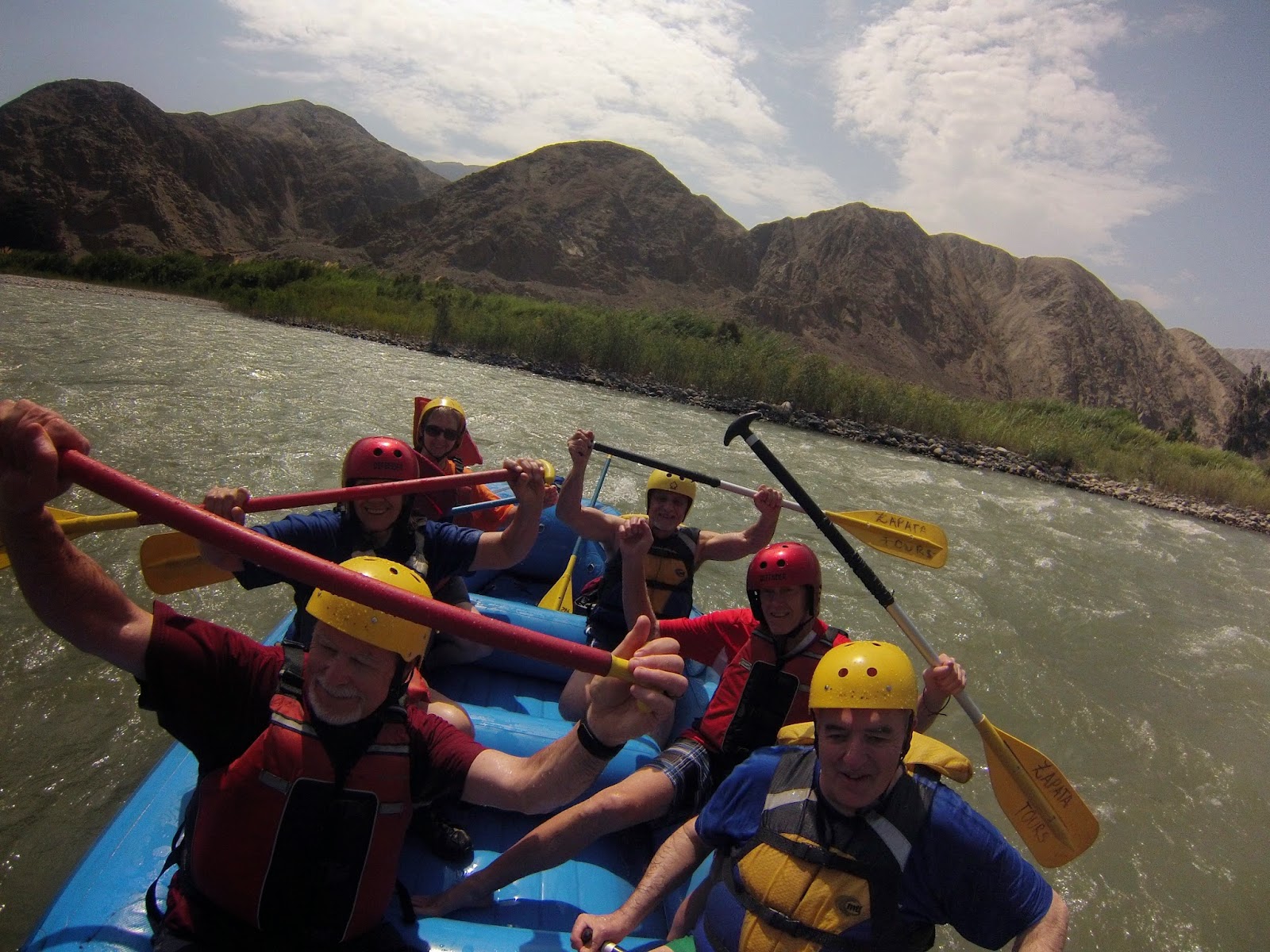
 Then we went to the town of Luanhuena (check spelling) and to the sports emporium run by the Zapata family.  For 20 PS each, eleven of us choose to go white water rafting on the Rio Canete, five in the first raft and six in the second.  I got to ride at the front of the second raft.  They had a video camera mounted at the front to tape the entire ride, and to also take some photos of each of us.  

Kevin, Monica and Grace at the office for the rafting and ATV rides

One of several businesses that do the whitewater rafting
I bought the DVD from the river rafting.  Here are some of the photos.


Three people went for rides on four wheeled ATVs.  The rest of the crew spent time in town.  We all got back together for lunch that had been provided by the camp.

We then visited the swinging bridge – a suspension bridge that is for pedestrian traffic only.  There were many tourists there and many vendors on both sides of the river.   


Monica bought some local fruit – I think it is called bacqui.  It looks like a foot long green bean and has large black seeds wrapped with a white cotton like edible stuff – you eat the white stuff, and spit out the black seed.  It was a tasty treat.

Our last stop was Incahuasi ruins – Inca House.  This is another huge site that is an active excavation site and much work is going on.  I am amazed that this was a city of many thousands of people.  


Zenon took group photos of us on about ten cameras - I did not give him mine


There were a row of round pillars, one per room, something we saw at other sites as well

This round pillar was still upright
At the entrance, there is an amazing cactus that was in bloom – and the blooms were full of bees.


And then it was back to Palabra de Vida camp for dinner and to rest up for our first day of building.

Saturday April 5 - Lima and taking the bus to La Florida

This was a laid back sort of day.  Four more team members came in during the night: Jim and Marci from Portland, OR, and Mike and Sylvia from Philiadelphia area (they know each other and are traveling together on this trip, but are not a couple).  I had the light breakfast served by the hotel and worked on my classes.  Shortly thereafter more people arrived – sisters from Americus, GA, Deanna (an internal med doctor) and Valerie (a physical therapist).  Six of us went to Starbucks – surprisingly, they had no coffee.  Apparently there was some temporary issue with their plumbing.  So we had juice and some pastries, and got to know each other.  Finally, they got water and started serving coffee.  Checkout time at the hotel was noon, so we went back to the hotel and got our luggage out of our rooms.  Then we hung out until 2:00 when we walked to a Chinese restaurant for lunch – there were now nine volunteers, Monica and Zenon.  Beer, Inka Cola Soda, Coca Cola and a meal of noodle soup and four large entrees were shared and the total cost including a tip was 250 PS – less than $9.00 per person.

We walked back to the hotel, got our luggage and loaded into a van to take us to the local bus station – the Terminal de Cercanias de Lima.  We had to show our passports to get tickets which included assigned seats on the bus – our bus tickets were very much like boarding passes for flying – name, seat, passport number, routing, cost, etc.  We loaded our luggage and boarded just in time (only seconds to spare) with Monica and the nine of us (Xenon left us there and later drove to La Florida, after he met the rest of the group as they arrived at the airport).  We rode on a very nice bus operated by the Perubus company.


 It took us about three hours to get to Canete.  We then transferred to the small bus that would take us around for the rest of the week, another 30 minute ride to the camp where we will stay for the week.  Palabra de Vida (Word of Life) has a mission here – the camp is used as a retreat and conference center by their church, but also available for rent including meals and laundry.  We had dinner and then went to our rooms.  Mike G. and I are sharing one of four rooms in the men’s area.  Each room has space for twelve people on six bunk beds.  Our beds had sheets, a blanket and a pillow for us – nothing fancy, but more than adequate and it was just the two of us so we have all the space we need to spread out our stuff.

The rest of the group arrived late at the airport and then made the same trek by multiple buses here to camp and arrived a little before 4:00 a.m.  The group includes: Pam, a nursing director from Fort Wayne, IN, Debbie and Steve from Oakland, CA; Marcia works at Home Depot in Tyler, TX; Jean is a retired teacher from Bryn Mawr, PA; Mark is an engineer from Minnesota; and Mike, a retired school principal from Detroit.

Friday afternoon April 4 (continued) - Pachacamac and Lima


The Temple del Sol was built on the top of a hill overlooking the region, the Pacific Ocean to the west and the surrounding desert to the south, east and west.  We were able to walk about half of the way around it.  Zenon wanted to walk to the top of the Temple as he had done before, but the path was blocked off.  Apparently there was some excavation and/or restoration work going on and the path was blocked.  

As we walked and looked around, I was surprised to see a lot of flora – the landscape was very green outside the park and it appeared to be due to irrigation.  On the south side, there were two large polo fields.  I did see a water truck watering the grass.  I will have to research more to find out where and how they get water.


There was good signage at the park, with descriptions in Spanish and English.  When we got to where we had to stop and turn around, we were looking west to the Pacific.  There was the story of Cavillaca and Cuniraya.  Among other things, this mythological tale explains how the island of Cavillaca was created.


On our way back to the entrance, one of the signs told about the springs and canals that the Incas used to create their lush garden in the middle of the desert.  I did not need to do that further research as it was explained that there were springs throughout the valley – I am guessing that the springs are fed from the water that runs down from the Andes mountains.  The Incas created a system of canals to spread the water throughout the area.  


In the same area, we also saw the Mamacona which apparently would be the Incan equivalent of a Catholic nunnery.


On our way out, they were leading the animals from where they were grazing around the museum to an enclosure where they remain overnight.  They had the largest llama on a leash, and the rest of the animals followed in their enclosure.  


Their were many beautiful plantings around the museum, including these vines that grew up and over a covered area where there were Incan women selling some very beautiful handcrafts.


After we finished our tour, we drove north back to Lima, hitting some of the Friday afternoon rush hour.  Monica works for the Fuller Center.  She is a single mother who also is a Fuller home owner.  Zenon had called ahead and told her to meet us at the El Cebiche del Rey restaurant in 30 minutes.  Because of the traffic delays, she had been waiting nearly an hour by the time we got there.  Having been in a hot and dusty environment, we were ready for a cold beer and we were served Cusqueña beer – one of four Peruvian beers, this one is from Cusco.  We had more than one of these.

Since our restaurant was named for the king’s ceviche, and since Zenon told us the restaurant was clean and safe, we had the ceviche to start our meal.  The raw fish is marinated in lime juice based juices and served in a mound with a topping of red pepper and seaweed, with sweet potato on lettuce and corn around the mound of fish.  I like seafood, but have never enjoyed raw fish, especially sushi – but this surprised me.  It was very tasty and an excellent treat after a hot afternoon in the sun.

Scrumptious ceviche - the fish and octopus are marinated in lime juice, and then served with potato and corn, and hot red pepper and seaweed on top.
I forgot to take a picture before I started on the arroz y camarones (rice and shrimp with the heads still attached)
Our favorite beer in Peru, Cusqueña
 For our entrees, Kaye and I both got rice and prawns – the prawns are served whole.  I forgot to take a picture before eating, so this photo is of a half empty after Patty and I had taken our first serving from it.  Zenon also ordered a casserole of rice, vegetables and other seafood including vegetables, shrimp, octopus and langastinos - this was shared by all.

We walked through Plaza San Martin – we saw crowds around several street performers.


We then went to El Bolivarcito – this is where the pisco sour drink was created.  


 Pisco sours are made of the brandy like pisco with a pisco syrup, egg white, ice and a dash of Angastoro bitters on top.  The drink is very strong and powerful.  

From there, we walked through a pedestrian shopping area – there are two streets which do not allow cars for several blocks.  


They connect Plaza San Martin to the main square.  Around the main square are the seats of power in Peru and Lima – the residences and offices of the President, the mayor, the bishop, the bank, etc.  Interestingly, the legislature is not there, but is several blocks away – their lack of power is obvious.  


There were also beautiful gardens in the park.  Unfortunately, I am not the best photographer – of course, the fact that I had my pisco sour and finished the last two thirds of Kaye’s pisco sour may have had a minor influence on my photographic skills.


 And then it was back to Hotel Santa Maria for our second night in Lima.

Saturday, April 5, 2014

Travel to Peru and Friday April 4 - Lima and Pachacamac

We had excellent flights to Peru.  When I booked the flights, many months ago, I was concerned about delays in getting to Newark, so I booked a 6:00 a.m. departure.  This meant we had about seven hours in Newark until the 2:15 p.m. flight to Lima.  My eagle eyed wife saw that the Business/First class tickets were very reasonably priced.  Usually, it costs 400% or more for Business/First over the cost of coach - but it was only about 150% the cost of coach - so we went with that.  Our flight to Newark was in First Class and our flight to Lima was in Business Class with lay flat seats.  This was the first time I have flown like this.  The food and drink was excellent, served on cloth placemats with real china and silverware.  Each seat was a pod that had headphones, power outlets for your cell phone and laptop, and private console for entertainment.  Kaye Hooker, the woman who is leading our team, was on the same flight with us.  We all enjoyed the flight.

Kaye was in the row just in front of Patty and me

Immigration and customs were quick and easy.  Zenon Colque, the local Fuller Center director, met us at the airport and we were at our hotel in less than an hour after landing.  Hotel Santa Maria is a basic, relatively quiet hotel on Ave. La Marina in the San Miguel section of Lima:

http://www.jianhoteles.com.pe/sanmiguel.html

Saturday morning, we had the breakfast included with the hotel room rate: coffee, pineapple juice and rolls with butter and jam.  Zenon joined us around 8:30 for coffee.  After he left for his office (he owns and runs some factories), we went for a walk to the local Starbucks that we had seen on the drive to the hotel.  Along the way, I stopped at an ATM and got some Peruvian Soles.

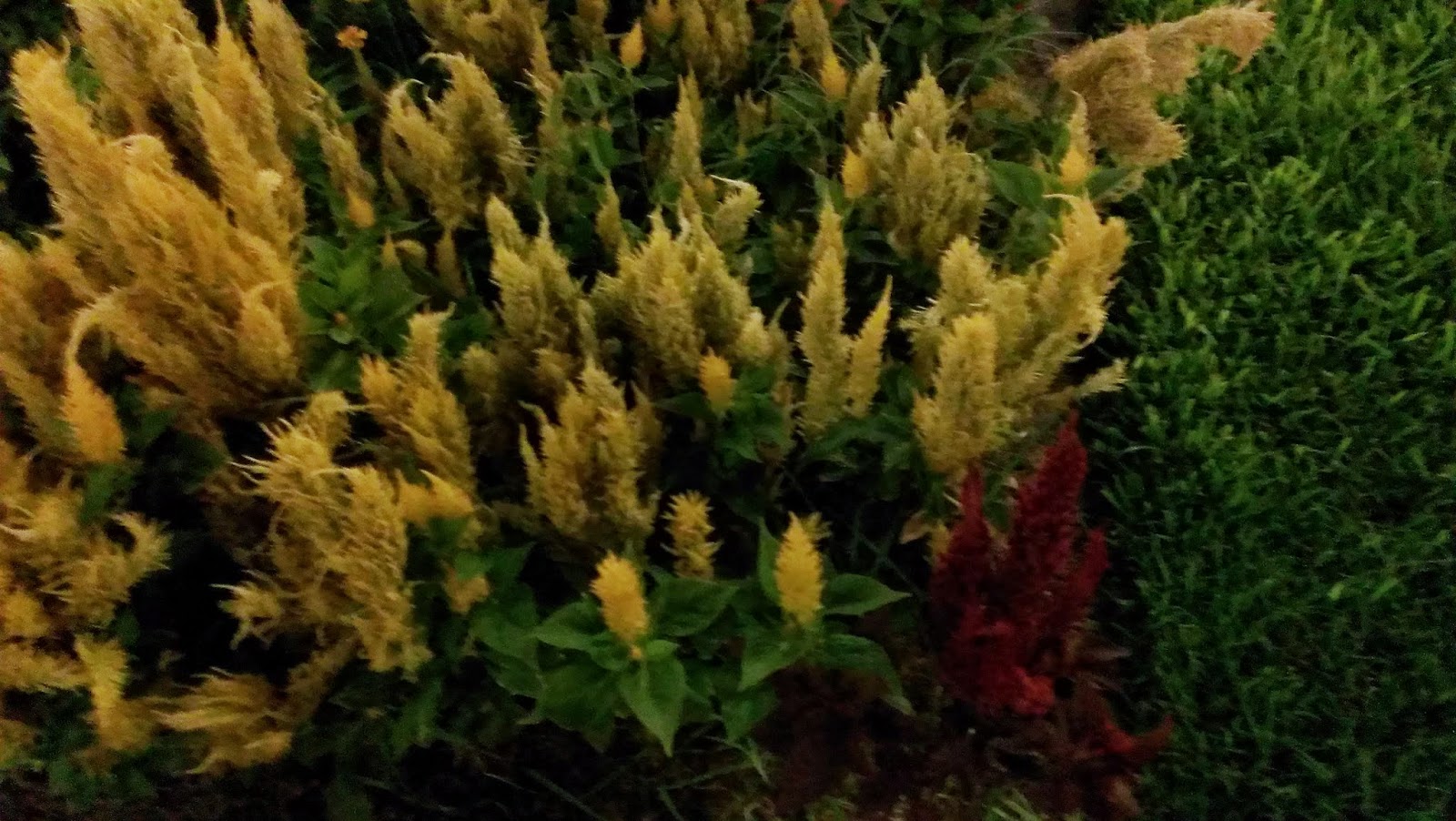
Outside Starbucks, there were these waist high lantana

We passed this nice park on the way to Starbucks

This is for my son Ben, who does Ironman Triathalons
We then met up with Zenon, and he took us to his office.  He drove us south to Pachacamac Ruins, a national park were they are preserving these ancient Inca ruins of a large religious center for the Incans.  I have since found that commercial tours would have cost each of us three more than $100 each: http://www.peru-explorer.com/pachacamac.htm.  Instead, we paid the 10 PS entry fee (one U.S. dollar equals 2.7 Peruvian Soles, so a little more than $3.50) and later bought Zenon and Monica (she is another Fuller staff person and is a homeowner from La Florida) dinner and drinks, and later pisco sours for less than 100 PS per person - still much less than the commercial tours.

The ride took us along a highway that was close to the ocean, where we saw many beautiful beaches and million dollar homes on cliffs on the other side of the highway.  I was sitting in the rear left, so I could not get photos of the beautiful beaches, but I did get a few shots of the cliffs on my side.


The Pachacamac ruins are in the Atacama Desert, believed to be in the driest part of the earth.  I was told they have had no rain for many years, but because of El Nino they are expecting some rain this year.  We really did see that we were in a desert, but there were areas of lush green in the desert.


There interesting cacti and succulents, as well as llamas and alpacas at Pachacamac.


We went through the museum and then spent a couple of hours walking around the ruins - we covered less than a quarter of the areas open to the public.


In spite of being in the middle of a desert, the Incas built this massive temple.  It is still an active archeological dig site, so in some places they are continuing to uncover more remains and in some places they have replaced some of the original parts of the temple so that you can see what it would have looked at.  The walls were primarily adobe which over time disintegrates.

Even though we were in the desert, there was lush greenery around us due to the system of canals.


I will post more later, have to go now to lunch and La Florida.

Tuesday, April 1, 2014

Where have the last seven months gone?

I last posted in August.  I have had an interesting interlude since then.  All fall classes have been finished, one winter class was canceled, and one spring class was cancelled but I have a student doing an independent study (she would have been in the class had there been sufficient enrollment) - that leaves me with only two classes and the independent study for the spring semester.  Assuming enough students, I have one class going for summer 2014 and three for fall 2014.  Our niece graduated from college in December and we went to her graduation in Norfolk, VA.  Our daughter endured the federal government shutdown before she and her boy friend went to Antarctica for the Austral summer - she to McMurdo Station, he to Palmer Station. They then vacationed in Thailand, went to visit their respective families and are now off to Alaska.  I have been back and forth between Vermont and Arizona eight times.  I did my shortest season ever as a volunteer docent at the Desert Botanical Garden.  I continued volunteering at the Habitat for Humanity ReStore until I injured my back in November; while I am well enough to do most anything, I am not at the level of fitness I was before the injury.  I did two sessions of Vaughan Town in February, the first week in Rascafria, Spain, and the second week in Gredos with Terry Bailey and Harry Burchstead.  My wife went to Arizona twice and continued working at the Visiting Nurse Association.  And our son is nearing graduation from medical school, finishing with emergency medicine at Landstuhl, Germany, and geriatric medicine in Sydney, Australia, plus some vacation time with his wife; in June, they will move to Portland, OR.

Spring is coming, but it has been a rough winter in Vermont - I have a long list of cancelled or delayed flights from the trips to VA, AZ and Spain.  While out walking the dog a week ago, I saw early signs of spring - the snow bank had melted enough to reveal a little bit of this car that was buried in the snow.


A week later, a little more of the car is visible and the snow bank is slowly shrinking.


Some sidewalks are clear of snow and ice, and some snow banks are almost gone.


But where there is not enough sun, many of the walks still are covered with ice, with large snowbanks that will be with us for weeks.


And now it is time to continue getting ready for our trip to Peru.