Saturday, September 20, 2014

Tour of Sofia on Saturday Sept. 20

After breakfast, we met at 10:00 a.m. and set out for a three hour walking tour of the city of Sofia.  Our tour guide was Denitsa or Deni (a different Denitsa unrelated to Denitsa the HFH coordinator).  Deni is working on her PhD in Russian history and thesis is about rent history since the fall of the Berlin Wall.

We started out at the Bulgarian Hall of Justice with a brief history of the three Bulgarian Republics and the intervening conquerors (Romans, Ottomans, Russians).  This was the ancient area called Thrace and the city was originally called Serdika.  Just as the USA has the bald eagle as a national symbol, Bulgaria has the lion (lev in Bulgarian).  The lion is on the coat of arms and the currency, which is called the lev.


We then went on to see some of the variety of religious institutions in Sofia - there is a Catholic cathedral, a Jewish Temple, a Muslim Mosque and a Bulgarian Orthodox cathedral.  All four co-exist and even though Bulgaria entered the war on the side of the Germans, Bulgarian Jews were never deported or sent off to gas chambers.


 Where a statue of Lenin looked across the square to what was then the Communist Party Headquarters, there is no a statute of Saint Sofia - which is ironic, since she never lived in Sofia, was opposed to pagan symbols (which are included on the statue) and has more of her bust showing than is appropriate for the Bulgarian Orthodox church.


Deni had us look at this casino because it has the coat of arms for the city of Sofia and explained the four symbols on the coat.


 Sofia was built like a cake, with the Roman ruins built upon in the dark ages and that was then built upon in modern times.  They are now working on uncovering the past for all to see.  In this square, my feet were at the Roman level, my body at the dark ages, and my upraised arms at the 21st century.

Note the minaret on the mosque in the distance and the Roman walls being excavated covered with sheets of plastic

The fifteenth century church

Another view of the fifteenth century church

Twenty first century entrance to the metro


More twenty first century evidence - the golden arches of MacDonalds

The Muslim Mosque

The Jewish Temple with the black roof
A police vehicle watching over the passing tourists
 We then went to the National Theatre building and the beautiful fountain in front.  There is also a National Opera House, but we did not go there.


Sofia is famous for its thermal waters - at the 20 or so public fountains, people were filling up bottles of the warm water, and we sampled it as well.  It had a bit of a metallic taste and was about 27 degrees Celcius.


The public baths were an integral part of the social life, as when they were built, most people did not have baths at home.  People gathered here, with women and men using separate ends of the building, each with their own pool.  The building is now being rehabbed and will be a museum.


We then walked through the lower level of these large Soviet era buildings which were built upon Roman ruins.  They have exposed the ruins in the subway entrances and underground passages.  These former Soviet buildings on the left and right are now government ministries and the former Communist Party headquarters in the rear is now Parliament.


The sign on the right says Central Department Store - that was the Soviet era main shopping store where people stood in line for hours to get what little was available
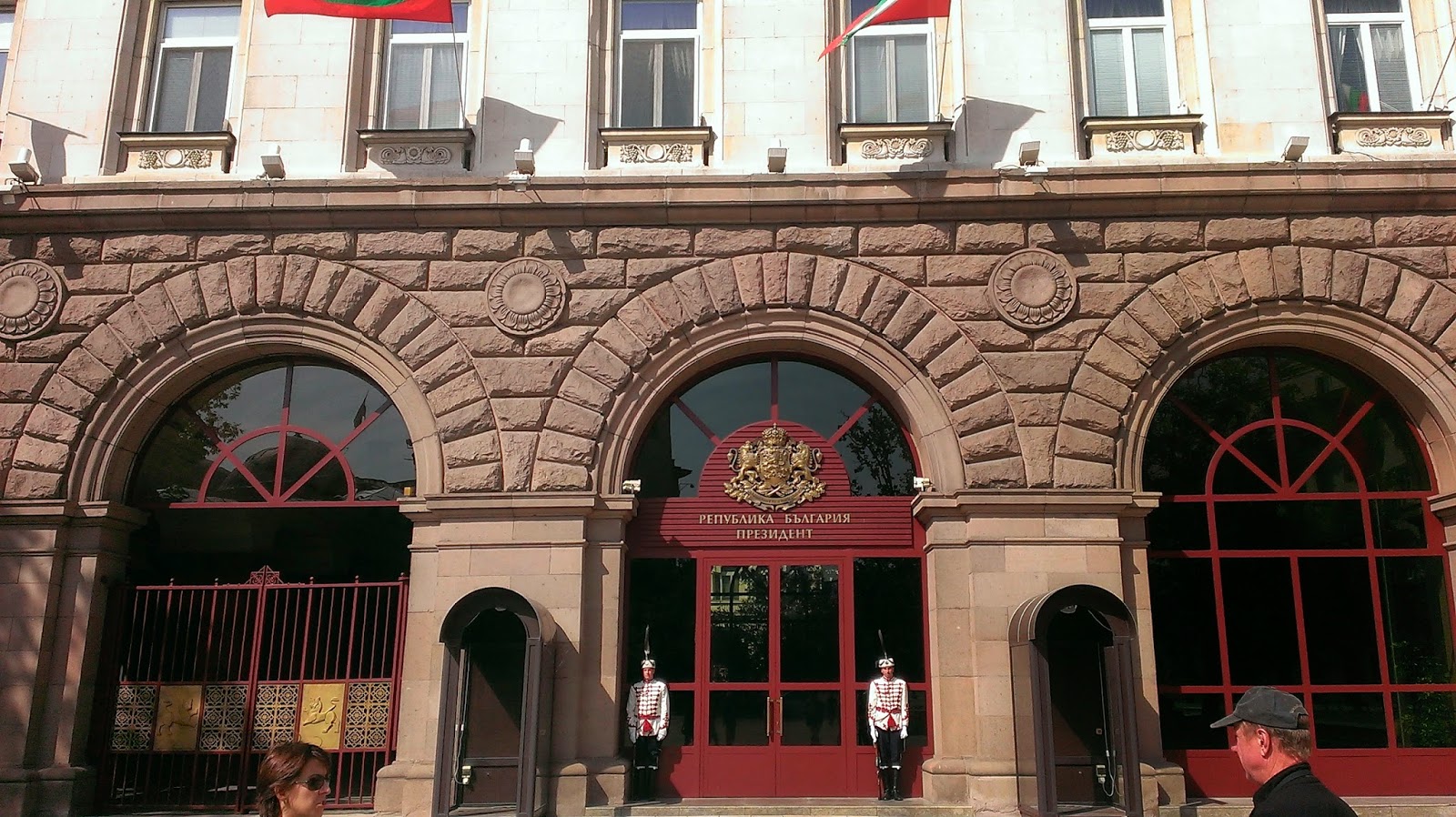
Next we went to see the Royal Guard - we did not get to see the changing of the guard, but they have some nice uniforms.  They must be between 1.78 and 1.82 meters and have blue eyes.  Until the government was sued a few years ago by a woman, there were always men.


In the courtyard behind the guards, there was another ancient church and Roman ruins - Ancient Temple Rotunda, St. George Martyr George the Victory Bearer.


We walked through many beautiful gardens.


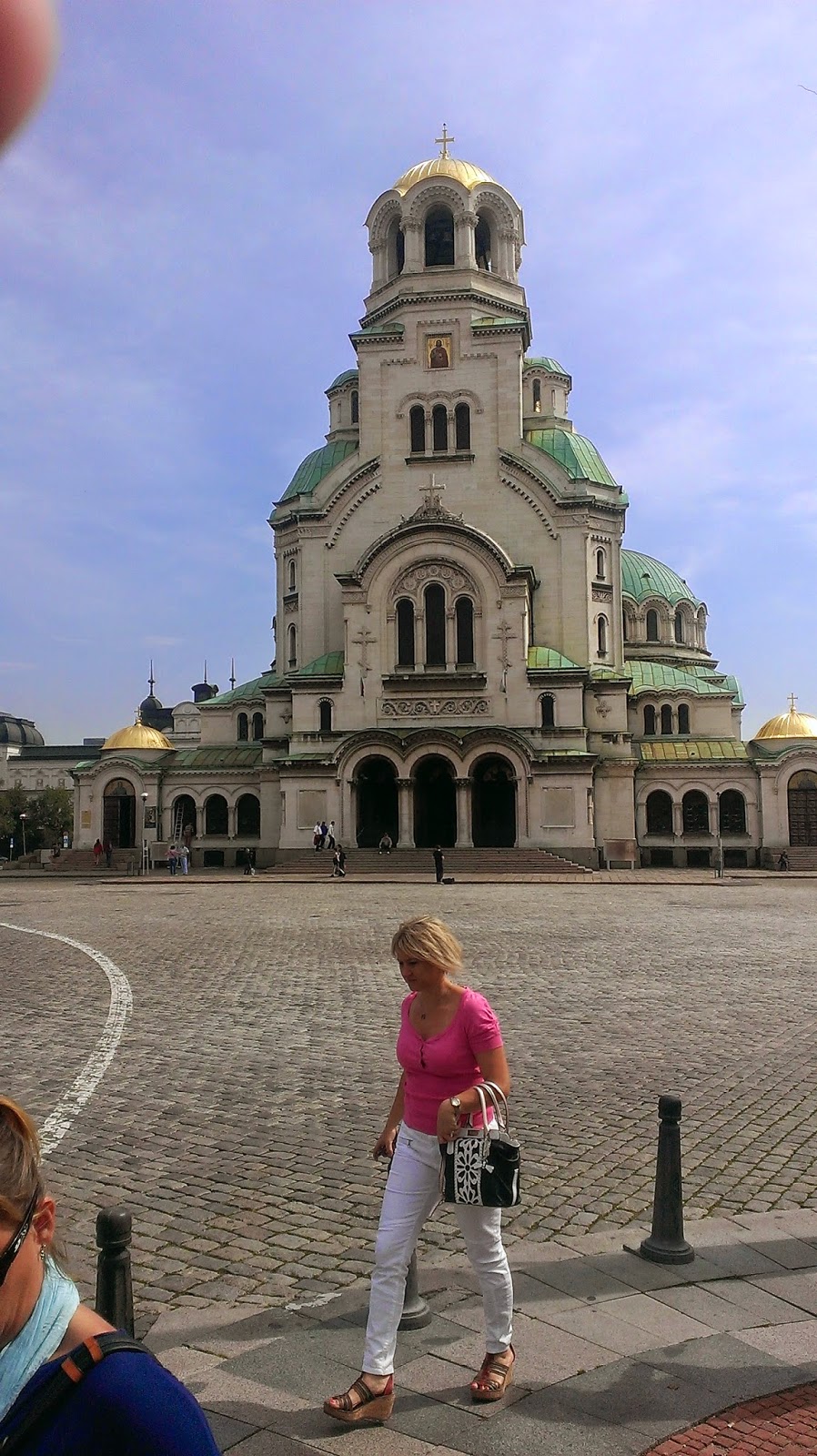
We ended our tour at the St. Alexander Nevski Cathedral - it can hold 5,000 people.  To say the least, it is very beautiful and ornate.


The Aya Sofia is across the street from St. Alexander Nevski.  It is older and much smaller.


We then went to the Mama Mia Espresso Cafe for a lunch of sopska salad, Wymehcko beer (a third Bulgarian beer), entree of chicken, fries and green salad, and a dessert of blueberry cake and ice cream.


Friday Sept. 19 in Sofia

Tom, another one of the Habitat volunteers had arrived two days before me.  We connected Thursday night after I finished that last beer and retired to my room.  We decided to meet for breakfast at 8:00 Friday.  The hotel rate includes a decent breakfast buffet with American style (eggs, ham, potatoes, etc.), Western European style (cold sliced cheeses, meats, tomatoes, breads), cereals, fruit, pastries, juices and a variety of coffees and teas.  It is easy to have a substantial breakfast.  I had previously made an 11:00 a.m. appointment to meet with the Public Information and Outreach officer at the American Embassy.  So Tom and I set out about 9:30 to walk the 45 minute trek suggested by Google Maps.  We went early so that if we got lost, we could always take a taxi, or if there as scheduled, we could have another cup of coffee.

Because I wanted to see the stairs and exit (in case of emergency) I took the stairs down from the 15th floor - they were nice, but rather bland.  But when I got to mezzanine, restaurant and lobby levels, the stairwell became very ornate.


Tom and I set out for the American Embassy as scheduled.  As we turned onto a major street, we came across a large construction project.  Since Tom is a building contractor, he was quite interested in how they were working - in America, once a floor has been framed, other crews come in to close in that floor and do the interior construction.  Here, it appears they frame the entire building before the do any of the interior.


We also came across more designated bike ways - Tom is from Portland, so he felt right at home with all the bike transportation.


We successfully navigated our way to the Embassy, and since we were early, stopped at the Happy cafe for a cup of espresso coffee.  We sat outside in the morning sun and enjoyed the day.


We then went to the Embassy, and since we were American Citizen visitors, we were allowed to approach the entrance.  The security was overwhelming.  Because I had made prior contact and was put on the approved visitor list, after giving up my passport, I was given a visitor badge and allowed to enter.  Tom had to wait outside for me to get through the next two layers of security and have the PIO call back to security.  Since this took about 15 minutes, Tom got tired of waiting and went back to the Happy Cafe (we had agreed that we would meet there if he could not get in).  The security makes the TSA look like kindergarten.  I had to turn off my phone and leave it there, along with all cables and batteries I had in my backpack.  I had to drink some water out of the clear plastic water bottle.  I had to take off my belt, watch, glasses and empty all pockets, then go through scanners.  After getting through those two layers of security, I then crossed another grassy area and went through another security checkpoint and was escorted to the PIO's office.  We had a nice chat about what I do with the Fulbright Commission and Habitat for Humanity, as well as with the JSC classes that I have taken to Brazil.  I also found out that she grew up in Huntsville, AL, and worked as a counselor at U.S. Space Camp in the early 1990s - it is possible that she was one of the counselors for my son Ben and the other kids I took to Space Camp back then.

After an hour, I made it back out through the security maze and retrieved all my belongings.  I met up with Tom and we walked back to our hotel by a different route.  We met up with Denitsa as scheduled at 2:00.  There were problems at the airport.  Tim and Donna made it in as scheduled, but the husband and wife volunteers from Tucson were not on the plane.  HFH had no cell phone numbers for them, just the land line number for their home in Minnesota and the brother of the wife.  So I called both.  I left a voice mail on the brother's phone, and on the Minnesota phone, they had left a Tucson number.  I called that number which turns out was their cell phone.  They were in Houston without their luggage - their flight from Tucson Thursday morning was delayed and the missed the connecting flight to Frankfurt.  They were staying in Houston and will be rerouted to Denver, then Frankfurt and on to Sofia on Saturday evening.

After everything was rescheduled, I went back to my and got my swim trunks and sandals.  The hotel has a 25 meter pool which is free.  I did spend 23 leva (about $15) to buy some goggles.  Tom and I then met a very gregarious swim and fitness instructor who spoke English and has traveled to the USA and through western Europe.  We then swam laps for a bit, found out about the sauna, and then went back to our rooms.  I took these photos looking east and west from the 15th floor - the city is quite large.


We met back in the hotel lobby to meet up with Bob and Caroline coming in from Rome where they had spent several days to acclimate to the time zone changes after flying from Billings, Montana.  Their flight into Sofia was delayed about 30 minutes.  But now we had six of the team members and two of the HFH staff, and we walked to the Mall of Sofia, a very nice shopping center - we had dinner in the Happy Cafe restaurant.  I got to try a second Bulgarian beer: Kameritsa.  Another nice day in Sofia ended with a pleasant walk back to the hotel.


Travel to Sofia, Bulgaria

Wednesday Sept. 17, I set out on my journey to Sofia.  Patty and I had coffee, then at 6:30 a.m., friend Jane picked me up at our condo and drove me to the airport (Jane works at Sky Harbor Airport in Phoenix).  I had an uneventful, on time flight to Houston on United.

For Houston, TX to Frankfurt, Germany, I switched to Lufthansa to fly on an A-380.  This plane is massive.  Downstairs, there are 420 economy seats in a 3 - 4 - 3 configuration.  Upstairs, there are 8 first class seats and 92 business class seats in a 2 - 2 - 2 configuration.  Boarding of the nearly 526 people went smoothly, but we were delayed because US Customs denied three passengers; this delayed our flight an hour while they got the six pieces of luggage off the plane, and getting a new place in line for takeoff.  The 9+ hours of flight was very nice - great meals and beverages.  The business class seat allowed me to stretch out, but it was still a rather hard seat - even for me.

That hour delay meant I had only 25 minutes in Frankfurt to get from the Z gates (gates built especially for the two levels of the A-380s) to the tram, then thru security and to my gate for the Lufthansa flight to Sofia - it took the full 25 minutes, and had the flight not been a few minutes late, I would have missed my connection.  Once on board, the flight to Sofia was a quick two hours and ten minutes.  Much to my surprise, my luggage made it with me.  Immigration and customs took less than 20 minutes.  I was then met by Raina from the HFH Bulgaria office and we rode a taxi into town to the Hotel Rodina: http://www.rodina.bg/EN/Home.htm  Hotel Rodina was built many years ago as one of the gems of the Soviet system and other than being old, it is a nice hotel.

At the luggage claim, I was welcomed to Bulgaria by Kobe Bryant
After getting settled in the Hotel, I went out to explore the neighborhood.  I found a different kind of Sesame Street.


The center of the traffic circle outside our hotel has a Soviet monument. And the cars all stop for pedestrians in the crosswalks.


Just in front of our hotel, there is a main street with multiple lanes, trolley tracks, a two lane access road and a combined bike path and pedestrian path, as well as sidewalks.


There is a chain of cafes/restaurants and bars called Happy.  This is two buildings away from out hotel and directly across from the Soviet monument above.


Like many other hotels, ours now also includes a casino - this one has a Porsche as a top prize.


My room is on the 15th floor and looks out to the north.  The curved building with the red roof has the Be Happy sign on, the white building is the D Commerce Bank and just to the upper edge of the bank, you can see the top of the Soviet monument and the traffic circle, as well as the bike path in the lower right hand corner.


After exploration, I ended the day with one of the local Bulgarian beers at the hotel cafe which has a covered veranda (it is one of several eating locations in the hotel).


Monday, September 15, 2014

A weekend in Arizona Wine Country

This past weekend started with Patty and me driving to Tucson.  We had lunch at In-and-Out Burger and were impressed with their cleanliness and quality of the food.  I then spent my usual two and a half hours donating platelets at the Tucson Red Cross.  This was only my second time doing a single needle donation and this time I was prepared.  I had my laptop, phone and grade book for working on my classes while hooked up to the machine.  Patty went shopping while I was at the Red Cross.

We then drove to Sierra Vista, where I taught Friday evening and Saturday until 2:30 p.m.  Then it was off to Patagonia, a lovely small town.  The owners/operators of the Spirit Tree Inn were volunteering at the Patagonia Community Gardens Pie Auction and Dinner, an annual fund raiser for the community gardens.  So we arrived too early to eat and explored the downtown area of Patagonia.  At one time, what is now the downtown is where the local railroads had multiple sidings and spurs, so there is a long, flat area which is now a pleasant park.  We walked the length and the first thing we found was a butterfly garden.  That is a pipevine swallowtail butterfly hovering over that flower.


Until we read the sign at the garden, we had no idea that there was such pollinator diversity there.


Patagonia is clearly a different town.  One of the jokes we heard was that Patagonia is an old hippie word for "can't afford to live in Senoita."  Senoita is the town to the northeast that is the heart of Arizona wine country and is very expensive to live and/or visit (that is why we stayed in Patagonia).  Across from the town hall is P.I.G.S.


The old train station has been restored and is now the town hall.  In front of it, they have installed a train semaphore - it was rehabbed and is one of the few left in the USA.


There are many hiking trails in the area and we decided that Sunday morning we would do the Train Track Trail.


As we returned back to our car and prepared to go to the Pie Auction and Dinner, we came across a coffee shop that even had a coffee cup out front for four legged friends.


We then had a pleasant dinner outside at the Community Gardens, met up with the Spirit Tree owners and after dinner, drove out to the Inn.

Our stay was in one of the casitas at the Spirit Tree - here is our kitchenette.  We had a large bedroom with a king size bed and the bath was between the bedroom and this kitchen area.


We had a delightful breakfast on Sunday morning.  After breakfast, I went out and took these photos of the Spirit Tree - it is a massive cottonwood tree some 160 years old, about ten feet in diameter at the base of the trunk and about 75 feet tall.  If you look closely at the first photo, you can see a two person swing at the base of the tree.


On the other side of the tree, there was another old cottonwood tree.  We later learned that it is common for cottonwood trees to partially die off and new growth to sprout from what appears to be the dead trunk.


Patty and I then went into the center of Patagonia to go on the Train Track Trail.  We walked for about 30 minutes in one direction and then returned.


This was the first sign we saw on the trail, after we got off the road.


This is the abutment mentioned in the sign - it is very hard to see.


In many places, the trail followed the old rail bed, in other places, it paralleled the old rail bed.


Here is where we turned around and walked out to the road to get back into the center of town.


We then cooled off in the shade before driving to Senoita, where we got a sandwich that we shared for lunch.  We went to five wineries where we bought a total of 18 bottles of wine, and sampled more than that.  In Elgin, they had this wine equipment on display in front of the shop which had wine from three wineries.


Before going back to the inn for dinner, we drove out into the national forest and saw a couple of interesting signs, one for a town forced to move and one with a warning.


Then it was back to the Inn for an excellent dinner.

Phyllo dough with artichokes, tomatoes and prosciouto; a cheese puff roll with basil; and kale chips with their special sauce.

The Phyllo and soup were paired with a local Reisling wine.

Cream of cauliflower soup.

Kale chips with special sauce; local Brussels sprouts; couscous; and lamb with another special sauce. Paired with local red wine.

Fresh quince with sauce and sliced almonds, served warm and paired with a white chocolate almond sweet dessert wine.