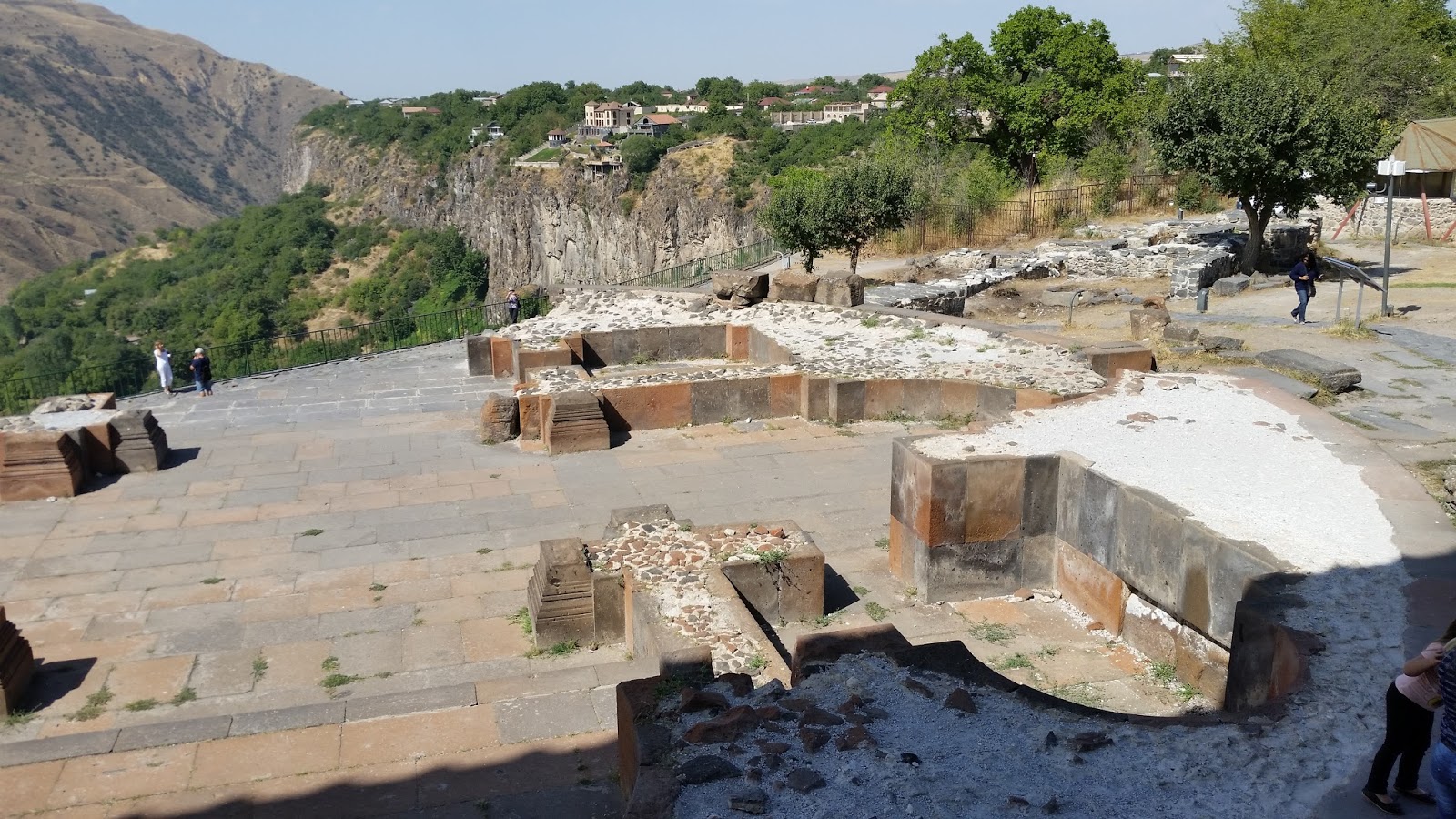
After a leisurely breakfast, we were picked up by the Fuller Center bus and headed off to the fortress of Garni. The excavations show people here as a early as the early bronze age in the third millenium B.C. Today, the main building has been rebuilt in the 1960s - you can easily see the mix of original pieces with those modern replacement pieces. The main building looks like a smaller version of the Parthenon in Greece. There are also the foundations of other castles and churches, as well as the royal baths fed by thermal waters. All this stands on cliffs overlooking the Azat River.
 |
| The front gate of the Fortress of Garni |
 |
| A view of the mountains |
 |
| One of the restaurants near the Fortress |
 |
| Some of the fox skins for sale |
 |
| The Temple of Mihr that has the same shape as the Parthenon in Greece |
 |
| One of the steles and another view of the rugged mountains in the area |
 |
| Inside the temple |
 |
| Inside the temple looking up |
 |
| Inside the temple looking out at the courtyard |
 |
| The foundations of the palace |
 |
| More of the palace foundations |
 |
| More of the palace foundations |
 |
| More of the palace foundations |
 |
| Looking out at the Azat river below |
 |
| Parts of the Royal Bath House |
 |
| The enclosed parts of the Royal Bath House were not open to the public |
 |
| Another view of the enclosed portions of the Royal Bath House |
 |
| General overview of Garni |
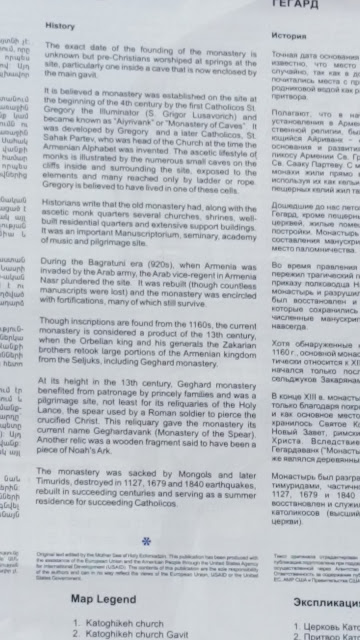
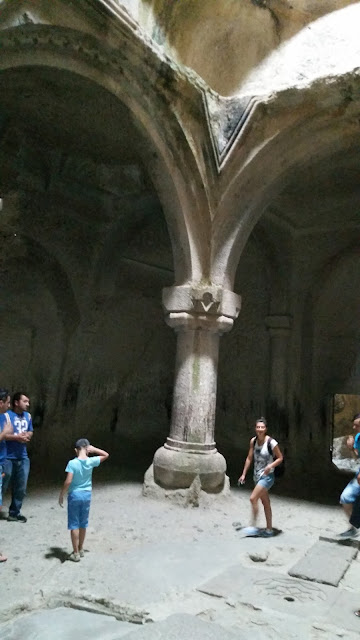
Then we went to Geghard Monastery. The monastery is still active. This is where the Geghard was brought. The geghard is the spear that pierced Christ's side when we was on the cross - it is now kept in a secure museum. The monastery is built into the side of the hill, so parts are added onto the hill but many parts are carved out of the stone that is the hill.
 |
| Large memorial markers on the road up into the monastery |
 |
| Local musicians playing the drum and two Tuduks (one melody, one harmony) - tuduks are a type of flute |
 |
| This is the newer part of the monastery and where the monks live today |
Then we went back to the town of Garni and had a great lunch. All of the tables are outside under a canopy of trees in a secluded courtyard. There were several other large busloads of German tourists, but we hardly noticed them. The restaurant also had a large aquarium - it was an above ground pool about ten feet in diameter and three plus feet tall, with transparent sides. Some of the fish were more than two feet long.
Then we drove about an hour to the other side of Yerevan to visit the family of the home that Boots and Ramsay worked on last year. The house looked great and gives us a good idea of what the future looks like when the home where we are working is finished. The husband is a long distance bus driver taking tourists to Georgia. They have three adult children who are now gone. They had fruit, pastries, juice, soda and Armenian coffee for us. A very nice visit to end our travels.
Saturday evening, for the first time since arriving, we did not eat as a group - we were given cash and went where we chose. John and Polly went out to a restaurant, I got a wrap from Sharma (somewhat like a Subway restaurant where you can pick the items in your wrap) and Boots, Ramsay and Lesylee went to our hotel restaurant after Lesylee had an hour long massage.
On Sunday, we went to Etchmiadzin Cathedral. The cathedral is just one building on this large campus of 25 - 30 buildings. The cathedral is undergoing external renovations and has staging all around the building. Inside, the cathedral is very much both a museum site and an active cathedral with church services - the 11:00 service began while we were there. Among other buildings in addition to the cathedral are several museums, residences for many of the monks and priests, and the residence of the head of the Armenian Apostolic Church - this campus is the Mother See and is comparable to the Vatican being the Holy See for Catholic Churches.
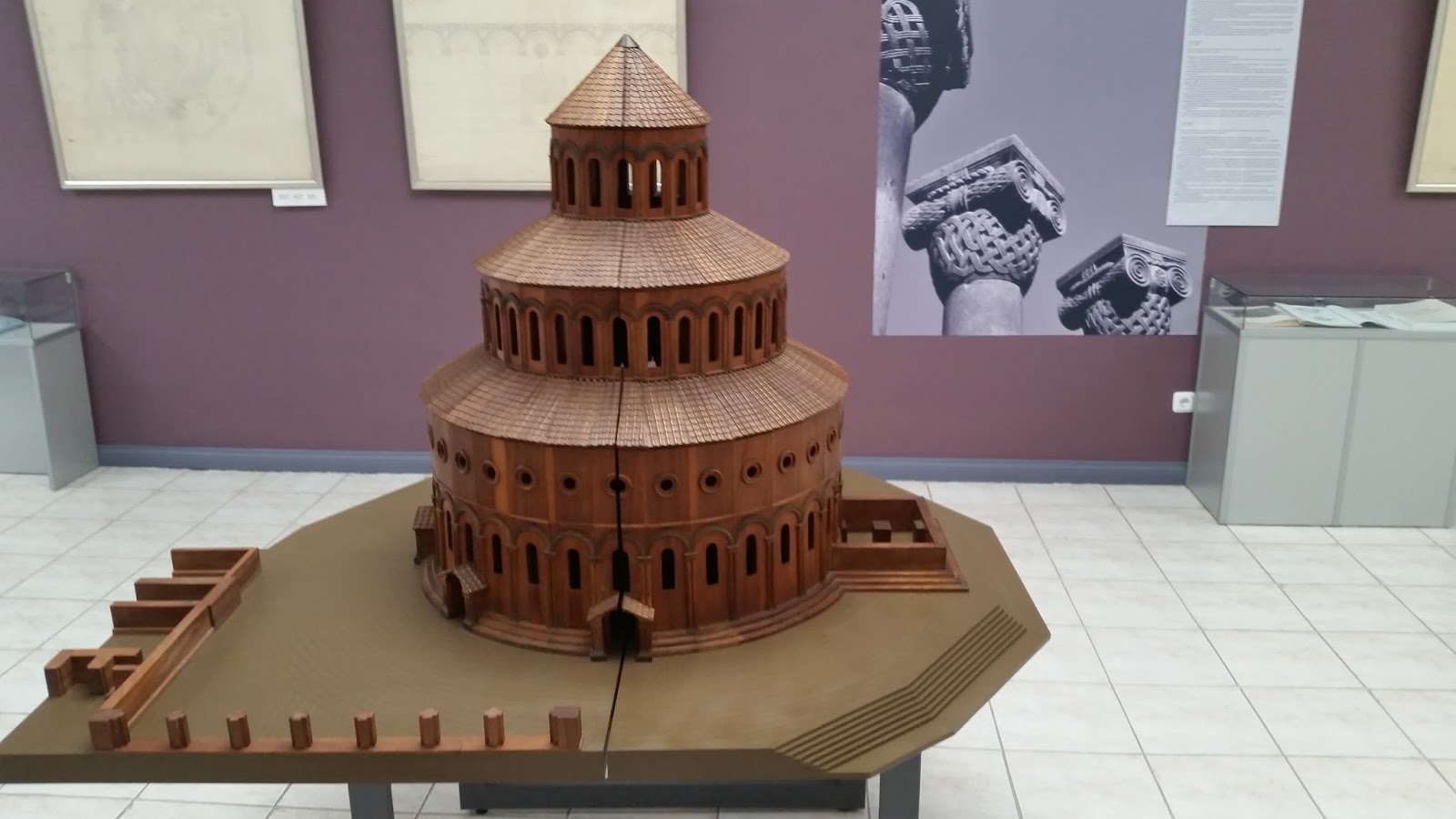
Next we visited the Zvartnots ruins. This had pagan roots going back millennia B.C. In the 7th century, a cathedral was built here and was the first of its kind to have this type of dome. Much archeological work has been done, and they have taken relics and worked them with replicas to show what the cathedral and other buildings would have looked like.
 |
| In their museum, they had many drawings of what the cathedral would look like, as well as this scale model |
After lunch, we walked to Yerevan's Vernissage street market. On the way, we passed some neat fountains and a large spider.
The street market is huge and has everything imaginable. It is definitely a place for souvenir hunters and home owners: Persian rugs, jewelry, pottery, artwork, books, sculptures, dishes, food, beverages, etc., etc., etc. I did not stay very long, but did walk through parts of it for about 20 minutes before going with John and having a beer.
For dinner, we had reservations for a table at Diamond Pizza. Our table was on the fourth floor on the corner closest to Republic Square. While they serve pizza, the menu is thick enough that there is a table of contents at the front of the menu. We finished eating just a little before 9:00 p.m. - and that is why we were at this location, as at 9:00 p.m. every night, there is a show with fountains, lights and music. (Once I get to a place with better internet, I will add a couple of videos.)