Thursday, April 29, 2021

Part II, Poland with Habitat for Humanity, June 26 - 28, 2011

 On Monday, we set off to work.  This is the building we were helping to renovate.


The ground floor has a large, two story high great room.  On three sides, there is a balcony with doors into private rooms that will become bedrooms with bathrooms.


One project was in the basement where we had to cut through the concrete floor to replace and reconfigure a drain pipe.
 

There are some 50 windows, each with two rectangular pieces at the bottom and two quarter circle pieces at the top, on both interior and exterior windows - 8 pieces per window for a total of 200 to scrape, sand and paint.


There was a lot of patching and sanding of walls in the rooms upstairs.


Lunches were delivered each day and we would usually eat outside.  On Monday, the NGO that will operate the center was there, and a TV crew interviewed them and us.


There was a whole campus of buildings, with chapels, schools and offices.


Each morning fter breakfast, we waited out in front of the hotel.  Tuesday was no different.


The day was spent working on windows, working in the basement and patching, sanding and prepping to paint walls.


 During a break, I explored the huge attic.


After work and showers, we toured a local brew pub and had a excellent dinner there.


On Wednesday, we stopped at Castorama - there are several European chain stores that are comparable to Lowes and Home Depot.  Castorama became our favorite stop each morning to pool money and buy tools to donate to the local Habitat chapter.  Our first purchase was a vacuum for cleaning the 15 years of dirt (the building had sat unused since 1995) - there was just a lot of dust and dirt to be cleaned up.

Late morning, we took a break and visited a chapel where a summer camp group was meeting.  Adam, the local Habitat director, was an organist and we all enjoyed a short organ recital.


After lunch, it was back to windows, prepping walls/ceilings and working on deconstruction of old bathrooms.


After work, we visited the Gliwice Radio Tower:

The Gliwice Radio Tower—the tallest wooden structure in Europe (at 387 feet)—still stands, although the station has long ceased to exist. Its building now houses a museum dedicated to the incident. The massive wooden tower now carries aerials for mobile phone services and FM broadcasting. The site itself now belongs to Poland.


This tower is often referred to as the place where WWII began.  Here is what Wikipedia says:

The Gleiwitz incident (German: Überfall auf den Sender Gleiwitz; Polish: Prowokacja gliwicka) was a false flag attack on the German radio station Sender Gleiwitz, staged by Nazi Germany on the night of 31 August 1939. Along with some two dozen similar incidents, the attack was manufactured by Germany as a casus belli to justify the invasion of Poland, which began the next morning.[1] The attackers posed as Polish nationals.

During his declaration of war, Hitler did not mention the Gleiwitz incident but grouped all provocations staged by the SS as an alleged "Polish assault" on Germany. The Gleiwitz incident is the best-known action of Operation Himmler, a series of special operations undertaken by the Schutzstaffel (SS) to serve German propaganda at the outbreak of war. The operation was intended to create the appearance of a Polish aggression against Germany in order to justify the invasion of Poland. Manufactured evidence for the Gleiwitz attack by the SS was provided by the German SS officer, Alfred Naujocks in 1945.[1]


Wednesday, April 28, 2021

Part I, Poland with Habitat for Humanity, June 21 - 25, 2011

When I started this blog ten years ago, I did not really know how to use it, so I simply put photos and comments on Facebook.  Now I have the time and in celebration of the ten years of blogging, I am making an actual blog post - actually, several of them about my first trip to Poland.

I had the opportunity to visit Krakow and Gliwice, Poland, June 21 to July 8, with Habitat for Humanity.  Instead of the usual project working with families who were investing "sweat equity" with us, this time we worked on the rehab of a 106 year old building that was being developed as a shelter for abused and houseless women.  It was a most rewarding experience, plus we got to visit Krakow (including the factory used by Oskar Schindler [and filmed in the movie "Schindler's List"] which is now a museum), the concentration and death camps at Auschwitz and Birkenau, and the Gliwice Radio Tower (the 110 meter tall wooden structure that was where WWII began). 

On Tuesday, June 21, I flew from Burlington to Newark, then on to Frankfurt and finally to Krakow, about 24 hours door to door.  Based on a recommendation of the HFH team in Gliwice, I stayed at a modest inn within walking distance of the center of Krakow.  I arrived on Wednesday, did a brief exploration of the city center and found dinner before getting a good nights sleep.    The old city is separated from new city by a beautiful green space.


The main plaza in the old city center is surrounded by beautiful old buildings and many places to eat - except that because of the holiday, they were not open.


The Vistula River runs along the south side of the city.


Thursday was the ninth Thursday after Easter, a Catholic holiday known as Corpus Christi.  Being a predominantly Catholic nation, Poland celebrates this as a major holiday.  Except for churches and tourist restaurants, everything was closed.  These photos are from some of the same locations as Wednesday's photos above.


Krakow was the home of Pope John Paul, so part of the city center paid homage to their native son.


After the ceremony was done, the main plaza was again empty.

And commercial establishments started operating.

Jagiellonian University was founded in 1365.  The famous scientist Copernicus attended school there around 1500.  On their website, they comment that Copernicus attended school here some 500 years ago, isn't it about time you did?  This statue with plaque commemorates his attendance.

As I walked the city, I saw some graffiti in English - my guess was that since the Iron Curtain came down and the Soviet Union fell apart, there has been some unhappiness with living in a capitalistic society and economy.

If you remember the movie "Schindler's List" you remember that Schindler saved many Polish Jews from the death camps.  His factory had just been opened as a museum (we could not take photos inside), but it was very moving, showing the three Krakows - life for the Nazis (very nice), life for non-Jewish Poles (not nice, but at least survivable) and life for Jews (death or near death).  I was able to take this one photo outside the museum showing some of the things made in Schindler's factory.

 
On the way back from the museum, I passed a couple of weddings and stopped for a photo in the main plaza.


Once most of the Habitat volunteers arrived in Krakow, we took a tour of Krakow that included a visit to a Jewish cemetery and learned that for most graves, rather than putting flowers on the grave, they placed small stones.


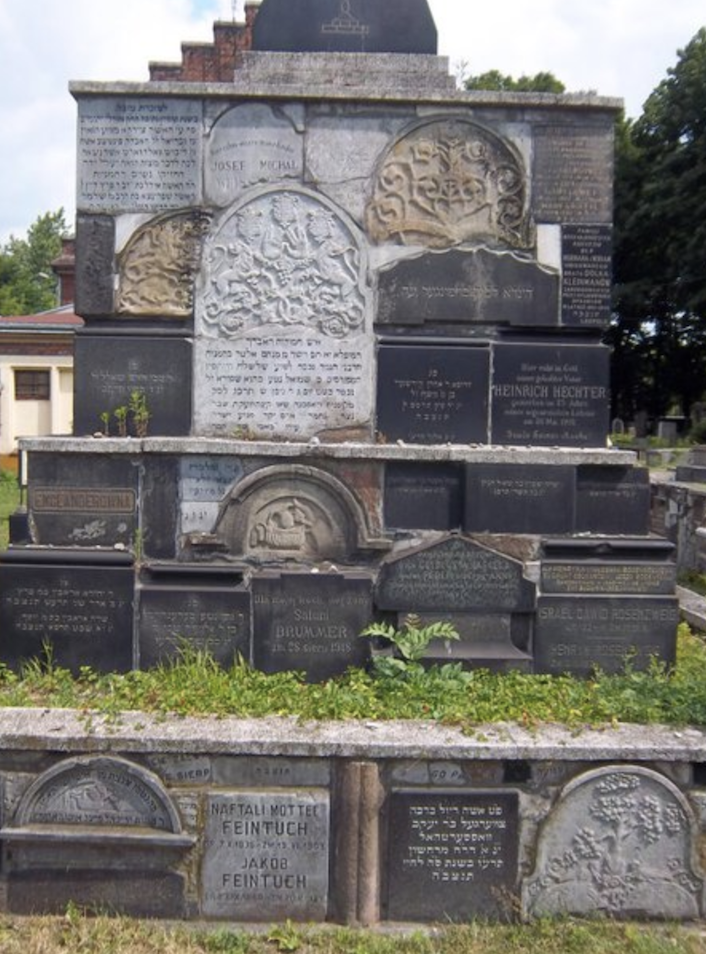
The Nazis needed stones for foundations for their new buildings in Krakow, so they took headstones from the Jewish cemetery and used them in their foundations.  Since then, those buildings have been carefully dismantled and the surviving pieces of headstones have been made into memorials in the Jewish cemetery.


The city tour took us to some Catholic cathedrals.


We saw more graffiti from angry young unemployed people.

We visited one of the famous synagogues.


Then we took a 90 minute bus ride to Gliwice, our home for the next two weeks.  


We stayed at what had been a dormitory for Schlonska Polyteknika University and was now run as a hotel.  And then we had a tour of Gliwice.  Like Krakow, Gliwice has an old city that was surrounded by a wall (now mostly gone) and a new city around the old city.  There was a nice main plaza with restaurants that we frequented several times during our stay.


This building was constructed in 1287.


We visited a local art museum.


And we had our first dinner in Gliwice here.